
Garage Door Opener Installation in Virginia: What Actually Matters Before You Buy
Garage door opener installation in Virginia typically runs $250–$550 depending on the opener tier and whether old hardware needs removal, and most jobs are completed in a single visit. Call us at (844) 643-0954 for a free estimate — we’ll confirm compatibility before you spend a dollar. Edward Campbell, our owner and lead technician, has seen too many homeowners in Virginia discover six months later that their new opener vibrates through the ceiling, throws sensor errors, or has a voided warranty because nobody checked the door first.
Virginia’s housing stock tells its own story. From the post-war rambler neighborhoods near Bailey’s Crossroads to the split-levels threading through Springfield and the newer townhome clusters around Tysons, garage door headers sit at wildly different heights, spring systems vary by decade, and framing quality ranges from rock-solid old-growth to the lightweight stuff that turns a chain-drive opener into a bedroom nuisance. The Ballston corridor where Edward grew up? Those 1950s and 1960s homes especially — low headroom, original torsion hardware, living space directly above. Installing an opener without auditing what it’s attaching to is how you get callbacks, angry reviews, and doors that eat their own rails.
That’s why we don’t start with brand recommendations. We start with a five-point compatibility check that big-box installers and franchise dispatchers routinely skip. Here’s what we’re looking at, why it matters for your specific Virginia home, and what it’ll actually cost.
What’s on Edward’s Five-Point Compatibility Check?
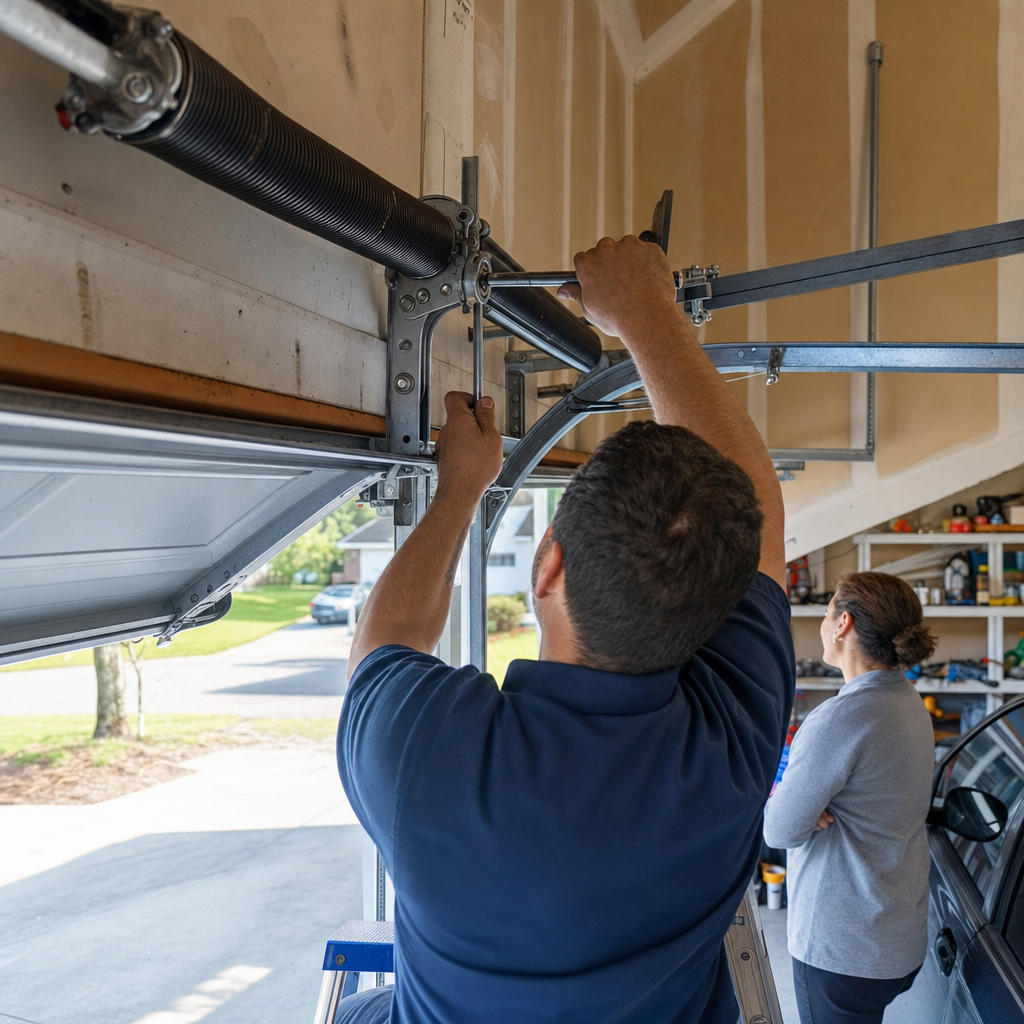
Every opener installation we do in Virginia begins with this audit. It takes about fifteen minutes, it’s included in our free estimate, and it prevents the three problems we see most: premature motor burnout, vibration transfer into living space, and safety sensor failures that leave your door reversing randomly or not reversing at all.
Door Weight vs. Motor Torque Rating
A standard steel panel door in Virginia weighs 130–180 pounds; a solid wood door or one with glass inserts can push 250–350. A ½-horsepower opener handles the light end fine. A ¾-horsepower unit is non-negotiable for heavier doors, and if your door’s springs are aging — common in homes around Annandale and Falls Church where original hardware from the 1970s still hangs — the motor compensates for poor spring balance until it burns out. We test spring balance first. If your door doesn’t stay put at waist height when disconnected from the opener, the springs need attention before any new motor goes up.
Header Clearance for Rail Type
Standard rail systems need 12–15 inches of headroom above the door in the open position. Low-clearance “jackshaft” or wall-mount alternatives like the LiftMaster 8500W need as little as 6 inches but require specific side-room and a properly balanced door. Virginia’s older neighborhoods — think the ramblers along Columbia Pike or the cape cods in Arlington’s older sections — often have finished garages with dropped ceilings or HVAC ducting that steals that clearance. We measure twice because cutting a rail on-site to fit is a hack, not a solution.
Existing Wiring Condition
Opener wiring in Virginia homes runs through attics, wall cavities, and sometimes exterior conduit that squirrels find delicious. Frayed low-voltage sensor wire is the single most common cause of “my door won’t close” calls after installation. We trace the full run, test continuity, and replace runs that show corrosion or damage — especially in homes near wooded lots in Vienna or Oakton where moisture and critter access are real factors.
Spring System Balance Test
We’ve covered this briefly, but it deserves its own line: an unbalanced door forces the opener to work every cycle. In Virginia’s seasonal humidity swings, springs fatigue faster than in drier climates. A door that tests heavy on one side — common on single-car garages in Fairfax City’s older stock — will twist the opener rail over time and throw the trolley off track. We won’t install on an unbalanced door. Period.
Trolley Compatibility and Brand Mixing
Not all opener rails mate cleanly with all door bracket systems. A Wayne Dalton TorqueMaster spring tube, for instance, needs specific header bracket spacing that a standard Craftsman rail kit doesn’t accommodate without modification. We’ve inherited too many Virginia installations where a previous owner or handyman force-fit incompatible parts with longer bolts and hope. That “solution” loosens, rattles, and eventually fails.
Here’s what this audit means in practice: when Edward shows up at your Virginia home, he’s not selling you the opener with the highest margin. He’s determining whether your door, your framing, your wiring, and your usage pattern point toward a chain-drive workhorse, a belt-drive quiet runner, or a wall-mount solution that keeps your bedroom above the garage actually quiet.
LiftMaster 8500W vs. Chain/Belt Drive: Why Virginia Framing Makes This Choice Real
The LiftMaster 8500W wall-mount opener sits beside the door rather than overhead, eliminating the central rail entirely. For Virginia homes with living space above the garage — common in the Ballston, Clarendon, and Shirlington corridor where Edward grew up, and increasingly in newer Fairfax County infill — this matters more than decibel ratings on a box.
Here’s the physics: chain and belt drives transfer vibration through the opener rail into the header board, into the joists, and into the floor above. Older Virginia homes with solid 2×10 or 2×12 joists handle this better. Newer construction with engineered I-joists or lightweight framing transmits more vibration, and dropped ceilings with drywall contact points act like speaker cones. We’ve had Virginia homeowners tell us their previous “quiet” belt drive still woke them at 5:30 a.m. when a spouse left for work.
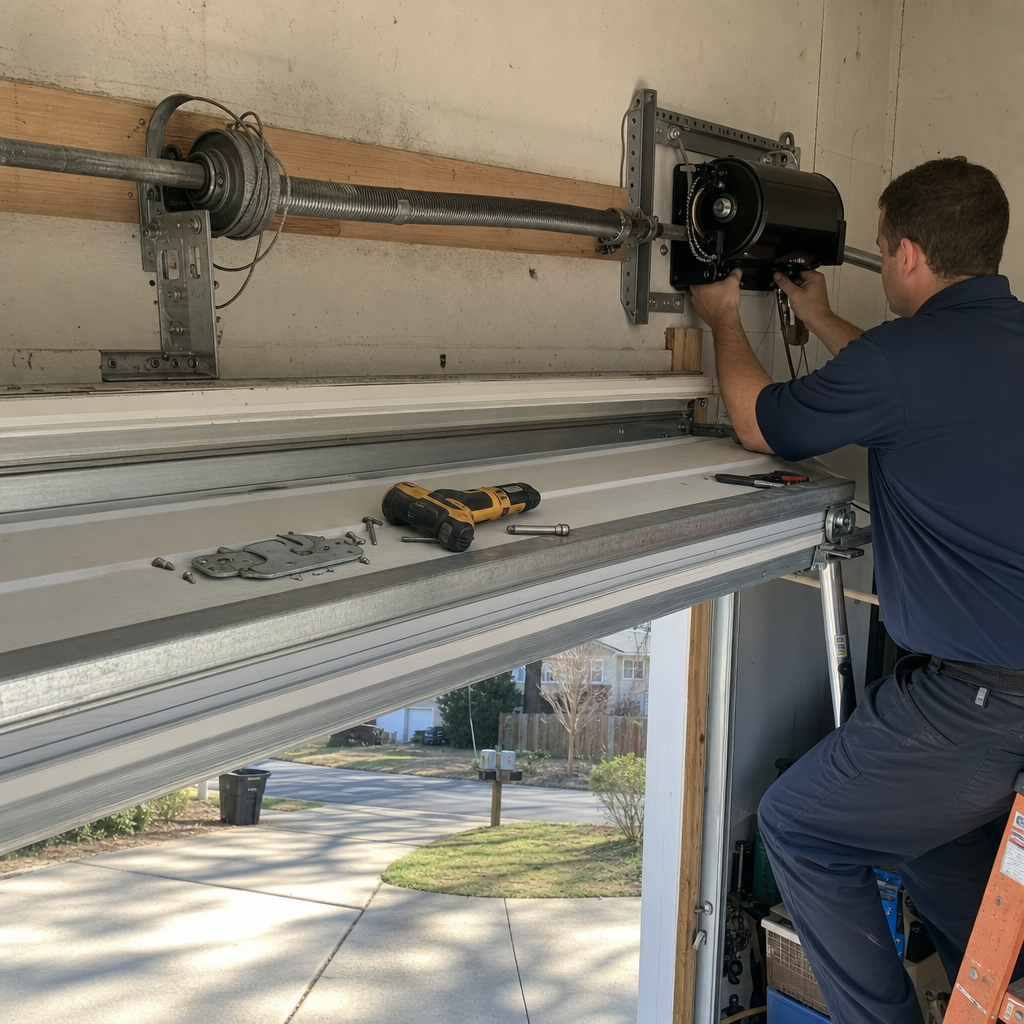
The 8500W eliminates that transmission path. It also requires less headroom, frees ceiling storage space, and pairs with LiftMaster’s myQ smart system. But — and this is critical — it demands a properly balanced door with functional torsion springs. The motor applies torque directly to the torsion tube; if springs are weak or mismatched, the 8500W works harder and alerts more. That’s why our compatibility audit is non-negotiable for wall-mount recommendations.
For homes without living space overhead, or for detached garages in Virginia’s older neighborhoods where noise isn’t the primary concern, a belt-drive unit like the LiftMaster WLED or Chamberlain B1381 still makes sense. The belt runs quieter than chain, the LED lighting is genuinely useful in dim garages, and the price point sits lower. We install what fits, not what we need to move.
Smart Opener Integration: The Wi-Fi Reality in Virginia Garages
Chamberlain’s myQ and LiftMaster’s equivalent smart features require stable 2.4 GHz Wi-Fi at the opener head unit. In Virginia, this trips up more homeowners than you’d expect.
Detached garages in neighborhoods like McLean’s older sections or the side-entry garages common in Burke and Lorton often sit far enough from the main router that signal strength drops below functional. Block walls, metal siding, and distance compound the problem. We’ve arrived for “my smart opener won’t connect” calls to find the homeowner’s phone showing one bar at the garage door and none at the motor unit.
Our audit includes a Wi-Fi signal check at the opener location. If you’re below -70 dBm, we flag it before installation and recommend a mesh extender or dedicated outdoor access point. Installing a smart opener without confirming connectivity is setting up a support call in week one. We’d rather have the conversation upfront.
Once connected, myQ genuinely works: remote open/close, delivery notifications, temporary guest access. But the hardware needs the signal. No signal, no smart features — just a very expensive standard opener.
What Does Garage Door Opener Installation Actually Cost in Virginia?
We’ve quoted the $250–$550 range. Here’s how that breaks down based on real Virginia jobs Edward has priced and completed:
| Component | Price Range |
|---|---|
| Basic chain-drive opener installation (no old hardware removal) | $250–$320 |
| Mid-tier belt-drive opener installation | $320–$420 |
| Premium belt-drive or wall-mount (LiftMaster 8500W class) | $420–$550 |
| Removal and disposal of existing opener | $50–$100 |
| Wiring replacement or extension (per run) | $40–$80 |
| Additional remote or keypad programming | $25–$45 each |
| Wi-Fi extender recommendation/supply (if needed) | $60–$120 retail |
These are installed, tested, and warranted prices — not “starting at” come-ons that balloon when the tech arrives. We don’t charge separately for the compatibility audit; it’s part of our estimate process. If your door needs spring or cable work before an opener can go on safely, we’ll quote that separately and explain exactly why. No bundled mystery fees.
For context, here’s where our other Virginia services land:
| Service | Price Range |
|---|---|
| Spring Repair | $180–$340 |
| Cable Repair | $130–$250 |
| Opener Repair | $120–$320 |
| Panel Replacement | $250–$500 |
| Track Realignment | $120–$240 |
| Roller Replacement | $110–$220 |
| New Door Installation | $700–$2,200 |
Why Owner-Operator Accountability Matters at Installation
Here’s a scenario we hear regularly from Virginia homeowners: big-box retailer sells opener, subcontracts install to regional dispatcher, tech shows up with a van and a checklist, door works day one, three months later it doesn’t, and the homeowner can’t reach the same person or even the same company.
Edward Campbell answers his phone. When a Virginia customer calls with a concern — a noise that wasn’t there before, a remote that intermittently fails, a door that seems slower — he’s the one who returns. Not a routing center. Not a subcontractor who wasn’t on the original job. The same hands that installed it diagnose and fix it.
This matters because opener installation has a 90-day shakedown period. Motors settle, brackets torque-check, sensors drift slightly. Having the installer reachable and responsive turns a minor adjustment into a ten-minute fix instead of a multi-day ordeal. Our home page has more about how we structure service after installation.
Eight years, one specialty. Whatever brand you have — Wayne Dalton, Craftsman, Raynor, LiftMaster, or others — we’ve worked on it. When your door won’t open or close, time matters. That’s not a slogan; it’s why we built the business.
Key Takeaways: Before You Buy an Opener in Virginia
- The compatibility audit prevents expensive mismatches — door weight, header clearance, wiring, spring balance, and trolley fit all matter more than horsepower.
- Living space above the garage? Consider wall-mount options like the LiftMaster 8500W to eliminate vibration transfer through older Virginia framing.
- Smart features need verified Wi-Fi signal at the opener location — detached and side-entry garages often need an extender.
- Installation runs $250–$550 in the Virginia market; the audit and estimate are free.
- Owner-operator accountability means the person who installs your opener answers for it afterward.
FAQs
Garage door opener installation in Virginia costs between $250 and $550 depending on the opener type and whether old hardware needs removal. A basic chain-drive install starts around $250, while premium belt-drive or wall-mount units like the LiftMaster 8500W reach the upper end. Call (844) 643-0954 for a free estimate — we’ll assess your specific door and give you an exact number.
Same-day installation is often available for standard chain and belt-drive openers when we have your model in stock and your door passes the compatibility audit. Wall-mount or specialty orders typically schedule within 24–48 hours. For urgent situations where a failed opener has trapped a vehicle or left a home unsecured, our Garage Door Opener emergency service prioritizes rapid response. Call (844) 643-0954 to check same-day availability.
Opener repair typically costs $120–$320, while new installation runs $250–$550, so repair is cheaper when the motor, gears, and circuit board are fundamentally sound. We recommend repair for units under ten years old with isolated failures — stripped gears, failed capacitors, or sensor issues. Replacement makes sense when the motor is burning out, parts are obsolete, or repair costs approach 60% of replacement. Edward will show you the specific failure and explain both options honestly. Call (844) 643-0954 for a diagnostic — estimates are free.
Intermittent smart opener connectivity almost always means insufficient Wi-Fi signal strength at the motor unit, common in Virginia’s detached garages and homes with block or metal construction. The opener needs stable 2.4 GHz signal; if your phone shows weak or no Wi-Fi at the opener location, the myQ or equivalent app can’t maintain communication. We test signal during installation and recommend a mesh extender or outdoor access point when needed — typically a $60–$120 fix that prevents ongoing frustration. Call (844) 643-0954 and we’ll diagnose whether it’s a signal issue or a hardware problem.
Ready for a Proper Opener Installation in Virginia?
Don’t buy an opener based on box specs and hope it fits. Let Edward run the compatibility audit first — door weight, header clearance, wiring condition, spring balance, and trolley fit — so you get the right unit installed once, without callbacks or surprises. We’ve completed hundreds of installations across Virginia’s varied housing stock, from Ballston ramblers to Fairfax townhomes, and we know what works where.
Call (844) 643-0954 today for your free estimate. Tell me what it’s doing and I’ll tell you what it needs — no guesswork, no runaround.
Written by Edward Campbell, Owner & Lead Technician at Regal Garage Door Repair Virginia, serving Virginia, VA.