
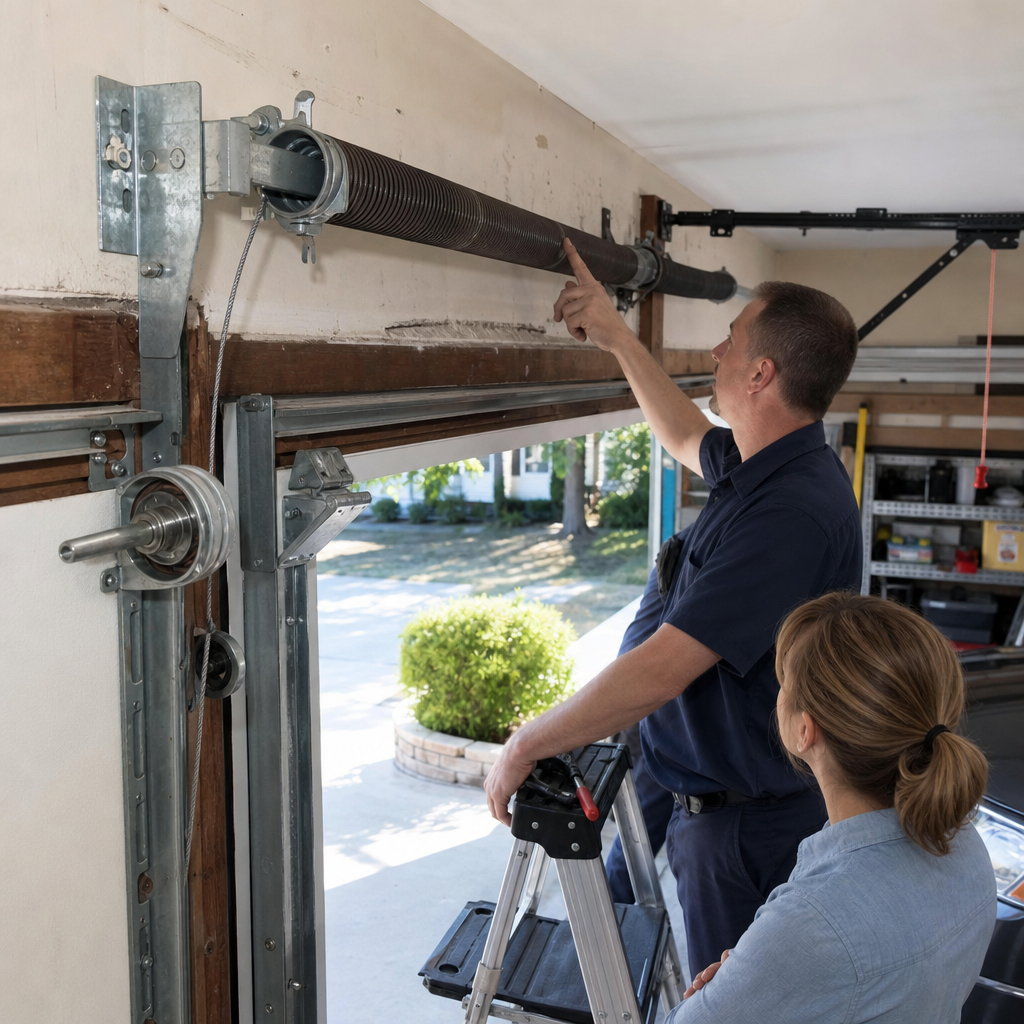
Why Your Garage Door Won’t Close in Virginia — And What the Season Tells Us
A garage door that won’t close is most often caused by misaligned safety sensors, a blocked or dirty sensor beam, or a remote or wall button sending a constant signal. In Virginia, seasonal humidity and cold snaps add a local twist: summer expansion of wooden door sections and winter contraction of metal tracks create binding that mimics opener failure but needs a completely different fix. If you’ve checked the sensors and the door still won’t budge, call Regal Garage Door Repair Virginia at (844) 643-0954 — we diagnose over the phone and dispatch same-day when needed.
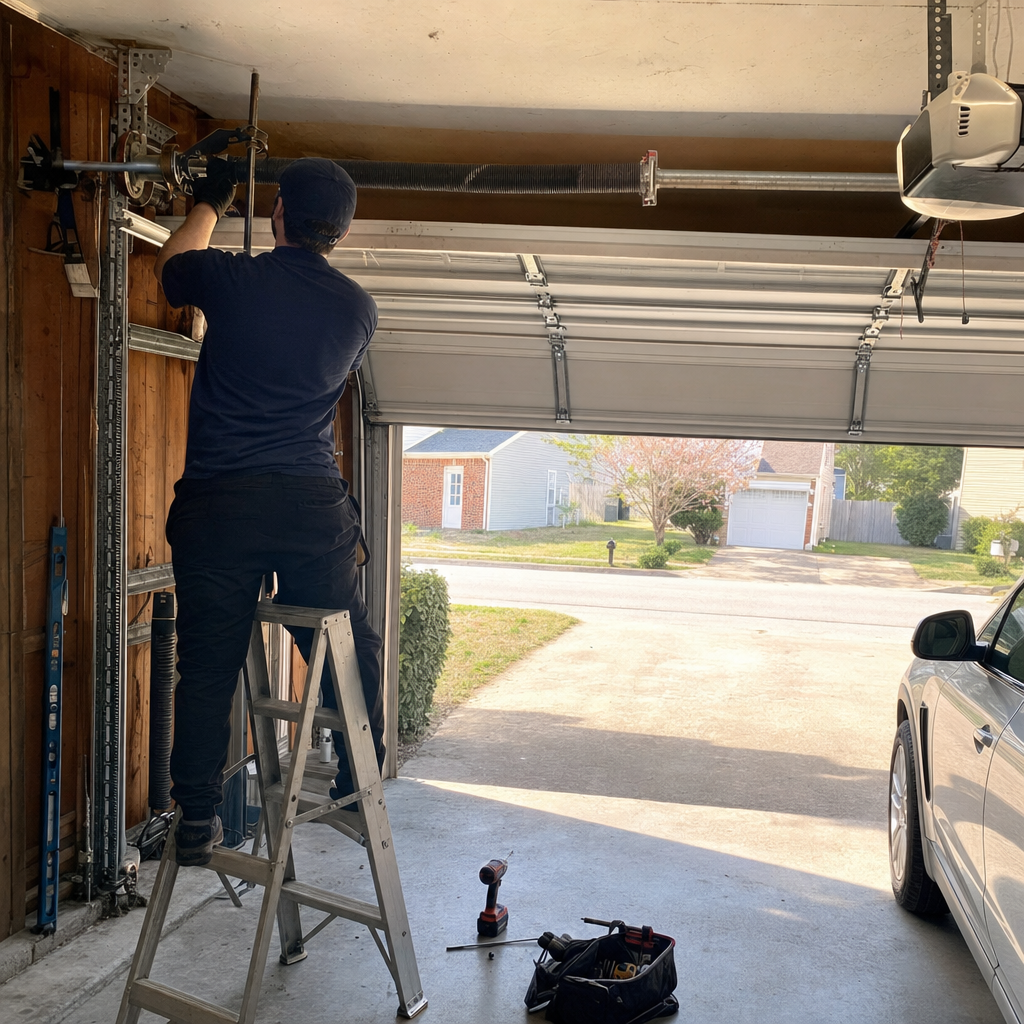
What Virginia’s Weather Does to Your Door (And When It Happens)
After eight years of answering “won’t close” calls across Virginia, we’ve learned to ask what month it is before we ask what brand you own. The climate here puts a predictable signature on failure patterns that generic troubleshooting guides completely miss.
Late summer humidity — think August afternoons in Ballston or Clarendon when the air feels thick enough to chew — causes wooden door sections to absorb moisture and expand. A door that cleared its frame in April suddenly binds against the track, and the opener’s safety logic interprets that resistance as an obstruction. The motor hums, reverses, or refuses to engage entirely. We’ve seen this on Clopay carriage-house doors in Old Town Alexandria and Craftsman systems throughout Fairfax County. The fix is rarely an opener repair; it’s usually track spacing adjustment or sanding swollen edges, sometimes both.
January cold snaps produce the opposite problem. Metal tracks contract, rollers stiffen, and grease that flowed freely in October turns to paste. Doors that haven’t been lubricated since spring — which is most of them, honestly — develop a hesitation at the same point in every cycle. The opener strains, the safety sensors get jittery, and eventually the system gives up mid-close. We’ve found this especially common on older LiftMaster chain-drive units in McLean and Great Falls, where homeowners tend to ignore maintenance until something breaks.
The pattern is consistent enough that we can often diagnose by phone: “When did this start?” tells us as much as “What model is it?”
The 60-Second Sensor Check That Fixes Most “Won’t Close” Calls
Before you assume your opener is dead, walk to the back of your garage and look at the two small boxes facing each other across the door opening, a few inches off the floor. These are the safety sensors, and they’re responsible for more “won’t close” symptoms than every other cause combined.
Here’s what to look for:
- Amber LED on the sending sensor — this should glow steadily. No light means no power; check the wire connection.
- Green LED on the receiving sensor — this confirms the beam is making it across the opening. If it’s off, flickering, or dim, the beam is interrupted.
- Both lights steady but door still won’t close? The sensors may be aligned but the logic board isn’t reading them. Unplug the opener for 30 seconds to reset.
If the green light is out, try this three-step realignment before calling anyone:
- Loosen the wing nut or thumb screw holding the receiving sensor bracket.
- Point it directly at the amber sender, watching for the green light to return.
- Tighten gently — overtightening is how they get knocked out of alignment again.
Spider webs, leaf debris, and even condensation on the lens can block the beam. We’ve driven to Crystal City for “emergency” calls that a damp paper towel would have solved. We’re happy to make the trip — Edward Campbell shows up himself — but we’d rather save you the service fee if it’s something this simple.
The Hidden Culprit: Your Wall Button or Remote Is Lying to You
This one confuses even handy homeowners because the symptoms look like catastrophic failure. Here’s what happens: a wall button with a shorting wire, or a remote with a stuck button, sends a constant signal to the opener. The receiver hears “open” or “stop” continuously, which overrides any close command. The door might move an inch, reverse, or do absolutely nothing.
We’ve walked customers through this diagnostic over the phone more times than we can count. Unplug the wall button from its low-voltage terminals on the opener head — usually two thin wires — and try the remote. If the door closes normally, you’ve found your problem. The button needs replacement, not the opener. It’s a $15 part and five minutes of work, not a $250 opener replacement.
Remote with a stuck button? Pull the battery and press every button hard a few times to free whatever’s binding. If you have a LiftMaster or Chamberlain with MyQ, the app can also get stuck in a command loop after a connectivity hiccup — force-close and restart it.
“Tell me what it’s doing and I’ll tell you what it needs — no guesswork, no runaround.” That’s how Edward handles every call, and it’s why we don’t show up with a sales pitch before we know what’s actually wrong.
Brand-Specific Quirks That Generic Guides Never Mention
Not every “won’t close” problem is mechanical or environmental. Some are buried in firmware and button combinations that homeowners trigger accidentally.
Genie openers have a “lock mode” activated by holding the wall button for ten seconds. In this state, the opener responds to the button but ignores all remotes and wireless keypads. The door appears broken — you press the remote, nothing happens; you press the button, it works fine. The fix is holding the button another ten seconds until the lock icon on the console disappears. We’ve had customers in Arlington and Falls Church ready to buy new opener systems over this.
Craftsman openers (especially pre-2018 models with the purple or red learn button) can enter a similar lock state through a sequence of rapid button presses. The manual calls it “vacation mode,” but nobody remembers reading that page.
Whatever brand you have — LiftMaster, Chamberlain, Genie, Clopay, Amarr, Wayne Dalton, Craftsman, or Raynor — we’ve worked on it. That’s not a marketing claim; it’s the reason we don’t waste your time with trial-and-error part swapping.
When “Won’t Close” Becomes a Security Emergency
There’s a difference between a door that’s inconvenient and a door that’s left your home unsecured overnight. We treat them differently because you should too.
If your car is trapped outside and you need to leave for work, or if your garage connects directly to your home and the door is stuck open after dark, this isn’t a tomorrow problem. Edward Campbell built Regal Garage Door Repair Virginia with emergency response as a core function, not an after-hours upsell. We stock springs, cables, sensors, and opener components for all eight major brands, which means most close-failure emergencies resolve in a single visit without waiting on parts.
Our Garage Door Repair service covers the full diagnostic and repair workflow, from sensor realignment to track replacement to opener logic board replacement when that’s genuinely required.
Typical costs for close-related repairs in the Virginia market:
| Repair Type | Price Range |
|---|---|
| Sensor Realignment / Replacement | $120–$240 |
| Track Realignment | $120–$240 |
| Opener Repair | $120–$320 |
| Cable Repair | $130–$250 |
| Spring Repair | $180–$340 |
| Panel Replacement (swollen/binding) | $250–$500 |
We don’t quote over the phone for complex failures — anyone who does is guessing — but we’ll tell you honestly whether your symptom sounds like a $120 fix or something more involved. Estimates are free.
What You Can Safely Check Yourself — And What You Shouldn’t
We’re not interested in charging you for two minutes of work you could do in your driveway. Here’s the boundary we draw:
Safe to DIY: Sensor cleaning and realignment, wall button disconnection test, remote battery and button check, visual track inspection for obvious debris, and lubrication of rollers and hinges with silicone-based spray (not WD-40 — it attracts dust and gums up in Virginia humidity).
Call a professional: Anything involving the torsion spring system above your door. These springs hold hundreds of pounds of tension and can cause serious injury or death if mishandled. If your door feels heavy to lift manually, or if you see a gap in the spring coil, do not attempt repair. The same applies to frayed cables — they can snap unpredictably under load.
Edward’s training through the trades program at Northern Virginia Community College emphasized this repeatedly: mechanical fundamentals matter, but knowing your limits matters more. We’ve seen the aftermath of well-intentioned midnight DIY attempts, and they’re not pretty.
Why Virginia Homeowners Call Us Back
Eight years, one specialty. That’s the short version.
The longer version: 825 customers have reviewed our work at a 4.8-star average, and Edward Campbell is the one who answers the phone, drives the truck, and handles the repair. No subcontractor rotation, no dispatcher guessing at symptoms, no invoice padding because “we’re already here.” When your door won’t close and you need someone who can explain exactly what’s wrong and fix it the same day, that’s the model that works.
We’ve earned our reputation in neighborhoods from Ballston to McLean to Old Town Alexandria by showing up fast, diagnosing accurately, and charging what we quoted. The owner shows up. Whatever brand you have. When your door won’t open or close, time matters.
FAQs
Most “won’t close” repairs in Virginia fall between $120 and $340, depending on whether it’s a sensor realignment, track adjustment, or opener repair. More complex issues like spring replacement or panel swelling run $180–$500. Call (844) 643-0954 for a free estimate — we’ll narrow that range based on your specific symptoms.
Yes — we carry sensors, cables, springs, and opener components for all major brands, so most close-failure repairs complete in a single visit. Emergency service is available when a stuck-open door leaves your home unsecured or traps your vehicle. Call (844) 643-0954 and we’ll give you a realistic arrival window.
Repair is usually cheaper if the opener is under 10 years old and the failure is a sensor, logic board, or gear issue — typically $120–$320 versus $250–$550 for replacement. We only recommend replacement when repair costs approach 60% of new unit price or when parts are obsolete. We’ll tell you honestly which side of that line you’re on.
Metal tracks contract in cold weather, and grease thickens, increasing rolling resistance that triggers the opener’s safety reverse. In Virginia’s January cold snaps, this is one of the most common seasonal failures we see. Annual lubrication and track inspection in fall usually prevent it entirely.
If you’d rather have it looked at, Regal Garage Door Repair Virginia offers a no-pressure assessment in Virginia — call (844) 643-0954.
Written by Edward Campbell, Owner & Lead Technician at Regal Garage Door Repair Virginia, serving Virginia, VA.