
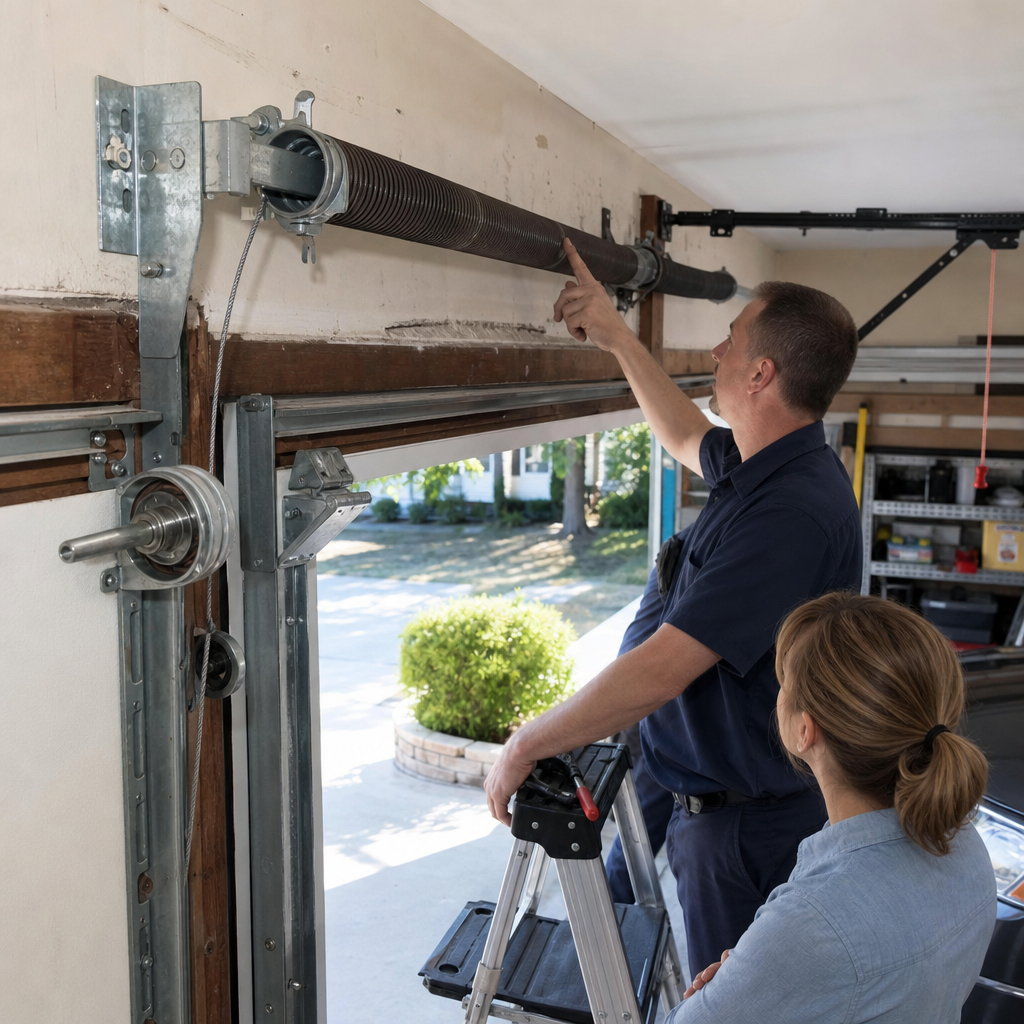
Why Does My Garage Door Reverse in Virginia, VA? The Real Cause Most Guides Miss
Your garage door reverses because its safety system is detecting resistance it interprets as an obstruction — and in our experience across Virginia, the most common culprit isn’t dirty sensors but a spring system that’s lost tension, forcing the opener motor to work harder and triggering the force sensor. The second most frequent cause is misaligned photo-eye sensors, followed by incorrect down-force limit settings. Most reversal issues run $150–$600 to resolve properly, and we can diagnose the exact cause same-day. Call (844) 643-0954 if you’d rather skip the troubleshooting.
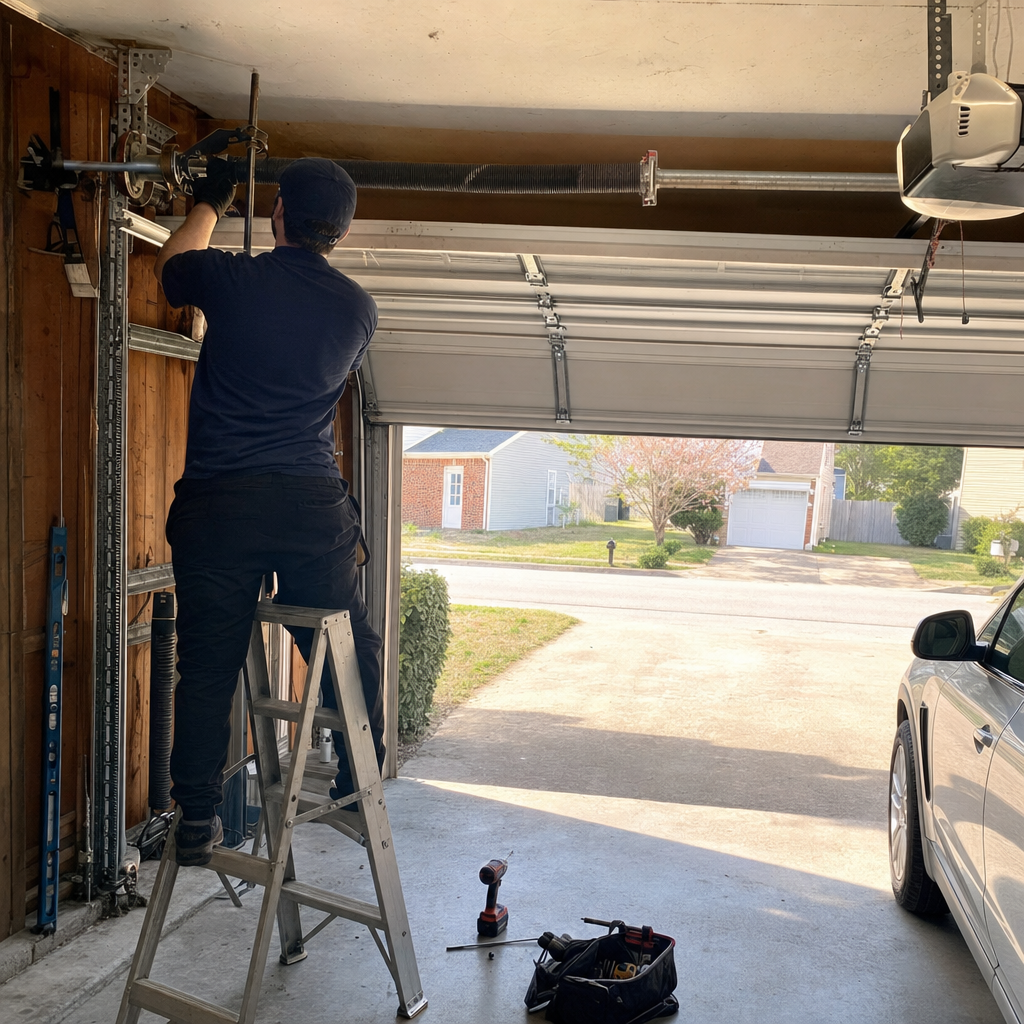
Last Tuesday we got a call from a homeowner in the Virginia Hills neighborhood whose door had been reversing for three weeks. They’d cleaned the sensors twice, adjusted the opener knobs they’d found on YouTube, and were about to buy a new opener online. Edward Campbell showed up, tested the spring tension with a winding bar, and found the torsion springs had dropped about 15% of their calibrated torque — not enough to fail completely, but plenty to make the Chamberlain opener’s force sensor think something was blocking the door. Twenty minutes of spring adjustment, a quick travel-module reset, and the door closed smooth as glass. The customer had nearly spent $400 on hardware they didn’t need.
That’s the pattern we see constantly in Virginia’s housing stock — especially the split-level and ranch-style homes built from the 1970s through the 1990s that dominate neighborhoods like Virginia Hills, Bellevue, and parts of Old Town. Those original doors and openers are still running, but the spring systems are decades past their design cycle. The reversal behavior is a symptom, not the disease.
The Diagnostic Sequence Edward Runs on Every Reversal Call
When your door reverses, the internet will tell you to clean your sensors. That’s not wrong — it’s just incomplete. Here’s the actual sequence we run, in order, because jumping to the wrong fix wastes money and can make the problem worse.
Step 1: Check Where the Reversal Happens
The location of the reversal is your strongest diagnostic signal before you touch anything:
- Reverses in the bottom 6 inches: Almost always sensor-related — misalignment, lens obstruction, or wiring damage from moisture in Virginia’s humid summers
- Reverses at mid-travel or random heights: Strong indicator of spring tension loss or track/roller drag — the opener meets variable resistance it can’t predict
- Reverses consistently at the same mid-point: Often a damaged track section, bent roller, or opener travel module that learned bad parameters after a previous repair
We ask this first because it tells us whether we’re looking at a $130–$250 sensor fix or a $180–$340 spring adjustment before we even load the truck.
Step 2: Test Spring Tension (The Step Most Pages Skip)
Here’s what generic troubleshooting guides won’t tell you: your garage door opener is designed to lift maybe 10–15 pounds of dead weight. The springs do the actual work of counterbalancing 150–300 pounds of door. When those springs weaken — which they do gradually, not all at once — the opener motor strains against progressively heavier effective load. The opener’s internal force sensor, doing exactly what UL 325 requires it to do, reads that strain as “I hit something” and reverses.
In Virginia’s climate, we see this accelerate for two reasons. The humidity swings from summer highs near 80% to winter dry spells cause steel springs to cycle through expansion and contraction more aggressively than in drier inland climates. And the older housing stock means many springs are original equipment from the 1980s or 1990s, well past their 10,000-cycle design life. We’ve replaced springs in the Bellevue area that had clearly been installed during the Reagan administration.
Safety note: Torsion springs store massive mechanical energy. Testing tension properly requires winding bars inserted into the cogs — never screwdrivers, never pliers, and never with the door connected to the opener. The release of a wound spring can cause serious injury or death. This is not a midnight YouTube project. If your diagnostic points to springs, call a professional.
Step 3: Verify Sensor Function and Alignment
If the reversal happens at the bottom of travel, we check the photo-eye sensors. Virginia’s pollen season — roughly March through May — coats sensor lenses in a film that’s invisible until you wipe it. But we also find:
- Sensors knocked askew by lawn equipment or kids’ bikes
- Wiring compromised by moisture in poorly sealed garage walls (common in pre-1990 construction)
- Sunlight interference on west-facing garages during late afternoon — a genuine issue in Virginia’s summer sun angle
Sensor realignment or lens cleaning typically runs $120–$240 if that’s the sole issue. We carry replacement sensors for all major brands, including LiftMaster and Chamberlain units, and can match whatever brand you have.
Step 4: Check the Opener’s Force and Travel Settings
Every opener has a down-force limit — the amount of resistance it will accept before reversing. These drift over time, and homeowners often “fix” reversal problems by cranking the force higher. That’s dangerous and, since 1993, violates federal safety standards. We use a calibrated door balance test to determine whether the force setting is appropriate for the actual door weight, not just turn a dial until it works.
For LiftMaster and Chamberlain openers manufactured after 2011, there’s an additional layer: the travel module “learns” your door’s movement profile during setup. If springs were replaced or the door was serviced without re-running the auto-setup sequence, the opener is working from outdated parameters. The reversal behavior looks like a hardware failure but is actually a programming artifact. We see this several times a month — a 30-second reset fixes what another company wanted to replace.
Step 5: Inspect Track and Roller Condition
Bent track sections, flat-spotted rollers, or dried bearings create intermittent drag that the force sensor reads as obstruction. In Virginia’s older neighborhoods, we find track damage from previous DIY repairs — homeowners who hammered dents “straight” and actually created high spots that bind the rollers. Track realignment runs $120–$240; roller replacement is $110–$220.
What Reversal Repairs Actually Cost in Virginia
Here’s the honest breakdown we give every caller. These are real ranges for our market, not teaser rates that balloon on arrival:
| Repair Type | Price Range | Typical Scenario |
|---|---|---|
| Sensor Realignment / Cleaning | $120–$240 | Lens obstruction, minor misalignment, wiring check |
| Spring Tension Adjustment or Repair | $180–$340 | Single spring adjustment; replacement if fatigued |
| Opener Force/Travel Recalibration | $120–$320 | Software reset, limit switch adjustment, module relearn |
| Track Realignment | $120–$240 | Bent section repair, roller path correction |
| Roller Replacement | $110–$220 | Worn or seized rollers causing drag |
| Comprehensive Reversal Diagnosis & Fix | $150–$600 | Full diagnostic with whichever repair applies |
We don’t charge separately for diagnosis if you proceed with repair — the service call includes the full diagnostic sequence Edward described above. Estimates are free and firm: what we quote is what you pay.
Why You Shouldn’t Override or Disable the Reversal Feature
We need to say this directly: the UL 325 standard that mandates automatic reversal has saved lives, including children’s. Disabling the sensors, jumpering the force limits, or otherwise defeating the safety system is illegal under federal law and genuinely dangerous. We’ve been called to homes where someone “fixed” their reversal problem by taping down the wall button’s constant-pressure switch — creating a door that won’t stop for anything in its path.
The right fix addresses why the system is detecting false obstruction, not how to make it ignore real obstruction. That’s the difference between a $180 spring adjustment and a trip to the emergency room.
When to Call Regal Garage Door Repair Virginia
If your door reverses consistently at the same height, if cleaning sensors hasn’t helped, or if the problem started gradually and has gotten worse — those are all signals of mechanical root causes, not quick adjustments. We’ve built our business on showing up for these exact situations: the calls where something doesn’t add up, where the obvious fix didn’t work, where you need someone who can read what the door is actually telling him.
Edward Campbell has spent his whole life within a few miles of the Ballston corridor in Arlington, and the mechanical training he got through Northern Virginia Community College’s trades program still shapes how he approaches every diagnostic. Eight years in, he’s the one who answers the phone, loads the truck, and stands in your garage explaining what he found. Garage Door Repair in Virginia is what we do — exclusively, not as a sideline.
Whatever brand you have — LiftMaster, Chamberlain, Genie, Raynor, or any of the other major manufacturers — we service it. Our home page has more on our full capabilities, but for reversal issues specifically, the diagnostic sequence above is how we work.
Eight years, one specialty. Tell me what it’s doing and I’ll tell you what it needs — no guesswork, no runaround.
FAQs
Most reversal repairs in Virginia run $150–$600 depending on the root cause — sensor issues trend toward the lower end, spring or opener work toward the middle, and combined problems occasionally reach the upper range. We provide exact quotes after diagnosis, and estimates are free. Call (844) 643-0954 to schedule.
You can safely clean sensor lenses and check for obvious obstructions, but spring tension testing, force limit adjustment, and opener module programming require specialized tools and training — and torsion spring work carries serious injury risk. If cleaning sensors doesn’t resolve the reversal, call a professional rather than adjusting settings you don’t fully understand. We’re available for same-day diagnosis at (844) 643-0954.
The most common hidden cause is weakened torsion springs forcing the opener to work harder than designed, which the force sensor interprets as an obstruction — this is especially common in Virginia’s older homes with original spring systems. Other causes include misaligned sensors, incorrect travel module programming on newer LiftMaster and Chamberlain units, or track and roller drag. The reversal location (bottom versus mid-travel) points to which cause is most likely.
Repair is almost always cheaper — opener replacement runs $250–$550 for installation plus hardware, while most reversal fixes are $150–$340. True opener failure causing reversals is rare; we find programming or spring issues masquerading as opener problems in the majority of cases. We only recommend replacement when the opener itself is genuinely failed or obsolete. Call (844) 643-0954 and we’ll tell you honestly which applies.
If you’d rather have it looked at, Regal Garage Door Repair Virginia offers a no-pressure assessment in Virginia — call (844) 643-0954.
Written by Edward Campbell, Owner & Lead Technician at Regal Garage Door Repair Virginia, serving Virginia, VA.